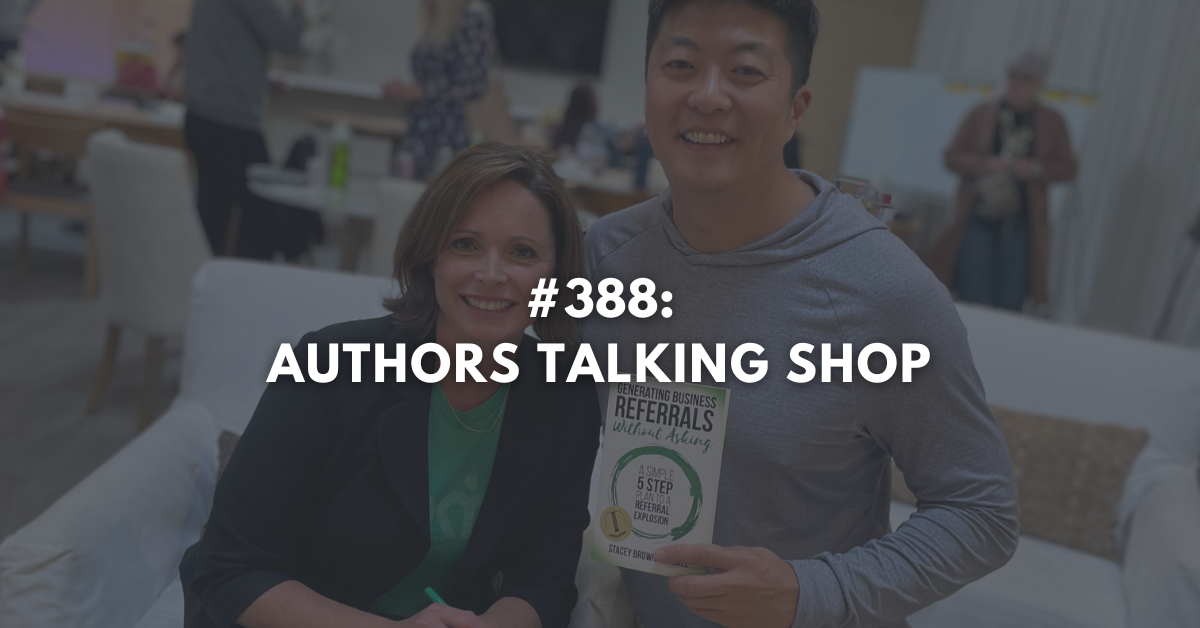
Ep #388: Authors Talking Shop
In this episode of the Roadmap to Referrals podcast, I had a great time reconnecting with my friend and fellow author, Mike Kim. We explored the journey of writing and publishing, particularly focusing on what it means to release a book in 2025.
The Evolution of the Author’s Journey
We kicked things off by talking about how the writing journey changes over time. I shared that it took me from 2018 to 2025 to get my second book out there. Honestly, I faced a lot of mental hurdles, especially the fear of not living up to the success of my first book. Mike pointed out that many authors experience similar feelings.
Storytelling Matters
One big change I made in my second book was a stronger focus on storytelling. I realized that starting with a good story really pulls readers in and helps explain complex ideas. Mike and I both agreed that incorporating personal and client stories makes the content more relatable.
Confidence in Content
With my second book, I felt way more confident in saying that being referable is essential for generating referrals. This confidence came from years of experience and knowing that my audience values depth over quick fixes.
The Writing Process: Finding What Works
We also discussed our individual writing processes. I used to isolate myself when writing, but the pandemic forced me to adapt. Mike described his method of stealing time whenever possible. We both acknowledged there’s no one right way to write; it’s all about finding what works for you.
AI in Writing
AI was another significant topic we covered. While I choose not to use it, Mike mentioned that it can be helpful for some but may detract from an author’s authenticity. We both agreed that our personal styles are what make our writing unique.
The Journey Continues
As we wrapped up, it became clear that the writing journey is ongoing. Both Mike and I are committed to refining our craft and exploring new ideas. For anyone considering writing a book, embrace your unique process and focus on telling your stories. Your perspective is valuable, and your journey is just beginning!
Want to watch this episode? Head over to my YouTube channel.
Links Mentioned During the Episode:
Download a free chapter of The Referable Client Experience
Mike Kim’s website
Next Episode:
Next episode is #389 which is another episode created with you and your needs in mind.
Download The Full Episode Transcript
Read the Transcript Below:
Stacey Brown Randall: Hey there, and welcome to the Roadmap to Referrals podcast, a show that proves you can generate referrals without asking or manipulation. I’m your host, Stacey Brown Randall.
I teach a science-backed methodology and framework that generates referrals without asking. This podcast and working with me is all about taking control of your referrals on your terms. Join me every week as I break it down.
Have you purchased your copy of my new book, The Referable Client Experience? If you haven’t, grab your copy today.
You can grab print, e-reader, or the audio book, wherever you prefer to buy books. You can also dip your toe in and download a free chapter at referableclientexperience.com.
Okay, today on the podcast, I asked my buddy, Mike Kim, to join me to talk shop. Specifically, author shop. Just a conversation between two authors about what it looks like to write and publish a book in 2025.
And when I was thinking about who would I want to come on the podcast and have this conversation with me, I instantly thought of Mike because he knows me well. So I wouldn’t have to tell him what questions to ask me. He would just know. He’d be like, oh, yeah, OK.
And he’s an author himself. So it’s not like him just interviewing me. It’s us interviewing and talking to each other. It’s not even like question, answer, question, answer. It’s more like conversation.
That was what I was ultimately after. It’s like, let’s just have a conversation. And we definitely get to that place, which is great. That’s exactly what I wanted this conversation to be.
So again, this is kind of like the final episode in our book series. We started back in October talking about the book and it’s live.
And then I had a conversation actually with my publisher. Then I tackled the three parts of the book over a couple of episodes. And I’m wrapping up with just a conversation between two authors.
Two authors talking shop about what it’s like to write a book, publish a book, have a book out there in the world, have multiple books out there in the world in the year of 2025.
So we talk about all the things you need to know about him and how we know each other and everything when we jump into the interview. So we’ll go ahead now and jump into the interview.
But I just want you to know that if you’re thinking of writing a book, this is another episode you’re probably going to want to listen to.
And even if you’re not sure if that’s something that you’re interested in, I think just listening to us talk about what’s changed, how we handled writing, AI. I mean, of course, we talked about AI. Can you go five seconds today in business without talking about AI?
I can’t even go five minutes in my house without talking to my kids about not using AI when they’re trying to write. So we talk about it all. So let’s get right to the interview. Let’s dive in.
Stacey Brown Randall: Okay, so Mike, I am so glad that you joined me today for this chat. It has been a hot minute since the last time I have seen you, so I’m glad we’re reconnecting.
And just as I said in the intro, but for the listeners, I just wanted to have Mike on because obviously we know each other. I have been in his mastermind for a couple of years and we’re both authors.
And I just think, you know, with the publishing of my second book, it kind of brings up conversations and discussions and questions from people. And I had a conversation on the podcast a couple episodes back with my publisher from Page Two.
And I thought, wouldn’t it be cool to have somebody on who knows me, we can have a conversation. It may be more like he’s interviewing me, but the purpose is for it to be a conversation for us just to talk about being authors and that process and that journey and just anything we really want to share that we think is valuable.
Mike Kim: Well, authors have a special bond, namely trauma, from writing and launching their book if they’re trying to do a good job of it, of course. And I know you do. I certainly always try to put my best foot forward when working on books.
And it’s one of those things that just never…it gets easier, but the weight always feels like the same. You get better at it. You find your own voice.
So I’ve written one on my own and then two co-writes. But I’ve done most of the lion’s share of the writing on those co-writes. My co-authors were cool with that. And I’ve ghost written one completely and then a developmental edit on the other one.
So you’ve now written two solo books. And as far as I know, you just sat butt in seat and were just writing. Was there anything different the second time around? Did you find it got easier? Did you find your process different? Anything along those lines?
Stacey Brown Randall: Yeah, so for me, I think, you know, the first book was published. I’m kind of embarrassed to say it. I mean, I talk about it, but the truth is the first book was published in 2018. And here it is 2025.
And I finally got the second book out of which I started on this one, in at least outline form in 2019, butt in seat, early 2020, like right before COVID hit, and then just used COVID as an excuse way longer than COVID should have been an excuse to just not get back to it.
And then finally, I was like, Oh my gosh, this is taking forever. This is going to hang over me forever. And 2024 signed my publishing deal for the second book.
It was like April of 2024. I was done with it earlier this summer. Then we did the audio recording, of course, and now we have our launch date in October.
So for me, it was actually more mental than it was anything else. The first book is good. Now that I have the second book, I’m like, oh, we are going to go improve the first book because I feel like a better writer.
And that’s one thing I wanted from the publishing company that I used. Like, I had four editors this time that I had to deal with. Last time it was one editor. And so everything about it is different.
But for me, the mental piece was, even though I thought my first book was great, probably until my second book came around, but my first book also won a bunch of awards. It won like three awards.
And so in my head, I was like, am I capable of doing another book that is as good as that one? And that’s only like rating the book on those couple of awards. But like, you know, eight years later, I still get royalty checks, like my first book still sells, people still buy it.
So it’s like a book that stood the test of time. I mean, I’m no Stephen King. I’m no Daniel Pink. I’m not selling like that. But for me, I took forever because I was like, am I capable?
Will it be as good? Will people like it? Will people like me? That whole thing we do in our heads that we know we shouldn’t be doing.
Mike Kim: I mean, that does not surprise me. I think that that second project is always really intimidating because you do the first one and the first one does well and you’re happy with it.
But you mentioned all this time that had passed. Of course, you’re going to become a better writer. You’re going to become a better communicator. You’re going to become a better thinker.
I always say that books really write the author. Everyone thinks that they’re writing a book on their expertise. It turns out the book is rewriting them, and it sort of clarifies your thinking, it sharpens your skills.
You see all the warts and all on your first book. I do. I’m surprised you want to redo the first one. I’ve thought about redoing my first one and I’m like, no, just move forward. Tell me a little bit about why you’re rewriting the first one.
Stacey Brown Randall: Yeah. So I’ve read your first book. It’s really, really good. I don’t think you need a rewrite. I think that it stands the test of time for you.
But for me, it’s more about when I wrote the second book and as my body of work developed in what I teach my clients, and that has been, you know, I’ve been in business now 12 years. And I would say that the strategy, the referral strategy that the first book is based on has been my signature foundational strategy from day one.
It’s the first thing I taught. It’s the first thing I figured out for myself. And it’s kind of always like, of course the first book would be written on that. But it wasn’t written in a way like, but this is one of 20 other strategies.
And so as my body of work has developed, I realized some of the positioning in that book doesn’t set it up the way that I think we set up things in the second book with this second foundational strategy.
And there are three foundational strategies. And in my world, I would be happy if those were just the three books and I just stopped. And I didn’t do it again. Maybe there’s a fourth one that’s like an all-encompassing umbrella book.
But really, it’s more about the positioning. It’s more about, it’s eight years later and the strategy hasn’t changed. But I’ve now been doing it for eight more years with clients and I have much better stories to tell.
We have this one bar chart that I show to folks when they’re doing webinars and things with me, and it’s a client that joined me in 2016, and there’s a bar chart of her every year of her referral and growth, and it’s just done this. And I’m like, that should be in the book.
There’s things in terms of now that this has stood the test of time, but there’s also a positioning of that strategy in that book and how I’ve positioned it that I just want to add some more to it. So that’s the thought.
The negative, right, is that you do a second book, you have to have a second Amazon listing, and you don’t really like, you kind of lose all the reviews and all the things from the first book.
And, you know, it’s like a whole big process of like taking your book back and taking your rights back, taking your book back and like redoing it. Anyways, it’s not a 2025 project. Clearly, it’s a 2026 project.
It’s kind of the game plan right now. And I’ve had some strategy calls with my current publisher about like, what would that look like? And do I want to do this? And is it the right thing to do?
And they’re much more like, whatever you want, we’ll do it with you if you want to. But you got to figure if it’s the right thing for you to do.
So as of right now, it’s the game plan. But you know, Mike, it’s like sitting down and doing another freaking book. Like, we’ll see. We’ll see.
Mike Kim: Yeah, no, I mean, I get that. I think there’s been a lot of temptation for me to do that because since I wrote my book, my book came out in 2021, and it’s on personal branding and personal branding as a topic has gone through the roof in the four years since.
I’m like, oh, I can update it for some new things, and I always see what I wish I would rewrite. But I’m also sort of like heading in a different direction. I don’t know what that is yet, but I just know that I want to leave it where it is and move forward.
But I get what you’re saying about all these different experiences that you’re counting in the book. I always tell people that you’ve got to earn the right to speak into the lives of other people. And the way you do that is you stress test your ideas. And you’ve clearly done that with your clients.
Did you try to make any intentional shifts in the second book compared to the first one where you might put more of your personal stories in it, more client stories? Were there any shifts around that side?
Stacey Brown Randall: Yeah, so I think there’s probably, if I really think about it, there’s probably more than just a couple of things that we probably did differently. I noticed with the second book, it was much heavier on stories.
So it was like, I didn’t start every chapter with a story, but I realized, wow, the books I enjoy reading, chapters start with stories. Sometimes my own, sometimes my clients, and sometimes other stories.
And so that’s definitely a part of it, is I’ve gotten better, I think, at writing stories and realizing, oh, that story connects here. I forgot about that. You know what I mean?
When they’re like, hey, you need another story, you’re like, how many more stories? I’m all out. And they’re like, no, you’re not. You’re just not thinking of them.
Mike Kim: Right.
Stacey Brown Randall: And so that’s different. I think, you know, one of the things that is not different about this book, but one of the things I feel like I got confident in is that I feel like people pick up my books and they’re like, just tell me what I need to say.
It’s like flipping to the end. And they’re just like, just tell me what I need to say. Tell me what I need to do. I’ll go off and do it. And that’s reducing my knowledge and my body of work to like, tiny little pieces and shreds. It isn’t actually what works and what I teach. There’s more to it.
And so this book, I was really clear that the first two parts, this book has three parts, the first two parts were going to be about being referable and what that means and what that looks like and what are best practices and pitfalls to avoid and things like that.
And then the third part would be about the referral piece and that I was totally fine with that balance. And it’s out of balance. Right?
But I was totally fine with that balance because I was like, you don’t need to worry about how you’re going to get referrals until you’re actually referable. But I feel like there’s, and that hasn’t changed in 12 years.
And there’s this constant, like, can I just get the shortcut? Can I just get the easy button? Can I just get the one thing? And I’m like, that’s not who I am. Like, I don’t work with business owners who are looking for the easy button. Like, that’s not what I do.
And I was nervous about it with the first book. This book, I was like, oh, hell yeah, this is exactly how it’s going to roll. And I’m totally fine with that. So I think that was probably something also, I was much more confident in what I was putting into the book.
Mike Kim: Yeah, I’ve written a couple books, like co-written, but again, I did the lion’s share. And I feel like now it’s a new normal and I’m probably always going to be writing something. And then I changed my marketing strategy overall.
Well, it’s not even a marketing strategy because I don’t know where I’m going. But I’ve always felt like when I’m boxed into a corner or where I feel like I’ve boxed myself into a corner, the only way to get out of it, you have to punch your way out of the corner.
I use a lot of boxing analogies for some reason or fighting analogies. And so I have just over the last month and a half of us recording this, I started publishing a weekly newsletter. These have been somewhere between 1,500 to 2,500 words a piece and I’m writing them week to week.
And so I actually feel like I’m writing a new book right now. I don’t know what I am writing about, but it’s all the stories that I have not really told before, and it’s weird how quickly they come to my mind.
Was it like that for you when you were writing the second one? You were saying a lot more stories, but your publisher is still asking you for more. Did it flow easier for you?
Stacey Brown Randall: I think it did. I think sometimes I had to go, you know, it’s funny. So I, on the wall that you can’t see in my office, I have like sticky notes up on the wall and it’s the names of all my clients and they’re color coded by the type of program that they’re in.
Like I am some like old school analog sometimes. And so I’m looking, I looked at that a lot and I’d be like, Oh, you know, I remember when. So looking at my clients’ names either helped me think about previous clients that I had that I was like, oh yeah, I remember when.
And that helped. But you remember, I mean, I started writing this book in 2019. So some of those stories still exist. They just had to be updated.
Like there’s a story I tell about a conversation I had with a real estate agent. And I interviewed him for the podcast, which it didn’t air because we just had other things going on. It’s just so bad for Brian, but I should probably have him back on.
But we went in and pulled the transcript. We’re like, yep, here’s the story. I remember it like it was yesterday. And so that’s one of the opening stories of the chapter.
When I was telling client stories, I’d be looking up. There’s a story I tell in the book about Jackie, who’s an architecture out in San Francisco.
And I remember looking at that board one day and being like, oh, I remember she said something about, like, this is when it clicked for me when I saw this piece that I taught her how to do that I teach in this strategy. I’m like, oh, we’re going to tell that story.
So in some cases, it was just like looking and remembering. Other times, I just had to sit. And I just, and particularly the personal story.
So the introduction opens with a story when I went to Europe the first time and how I, spoiler alert for anybody who’s going to go read the book, the opening story and the introduction is I missed my flight coming back from London.
But that led me, like that story came to me when we needed a story to set up how business owners ask sometimes the right questions, but at the wrong time. And it just came to me.
Sometimes I just think that writing language piece is a little bit of my superpower. And that story came to me. I’m like, oh yeah, that’s a perfect example of that. I could definitely use that.
So sometimes I was trying to make it happen by looking at my clients’ names and be like, what stories do I remember?
But I’ve noticed if there is a third book, I’m already starting. I have conversations now, I’m like, oh, that’s going in the book. I find myself doing that more now for the next book.
Mike Kim: What does writing or having two books now mean to you? Has that deepened your look at life? I know they’re business books and they’re books for your business, but you still wrote them. You’re still the same person.
This is a business side of your life that you’re sharing through these books, but when you look back on it, do you get a sense of fulfillment? Do you feel like, okay, I’ve left a mark on this world or is it more just like this was a business decision or is it somewhere in between?
I’m always curious how authors feel after they get especially multiple books out.
Stacey Brown Randall: Yeah. I mean, I think you probably know the answer to this because you know me. I’m way too practical to put that kind of time and energy in it for it not to have been a business decision.
I can write. God was like, here you go, Stacey. You’re going to know how to write. You’re going to probably stink at math your whole life, but you’re going to be really good with writing for the most part. I’m not the best, right?
So for me sitting down and writing, I don’t love it, love it. But when I get into the flow of it, I do love it. But it’s like the getting started.
So for me to sit down and be like, we’re going to do this again, it was, and I’m kind of embarrassed to say this, but I noticed that eight years later, my still and you, you preach and teach this to your people.
I mean, I know you’ve got people in your mastermind that you’re like, write a book people. And this, like, you can just take this little clip, Mike, and go play it for them when they tell you that they can’t.
But I realized eight years later, my number one lead magnet is still to this day on a monthly basis, not every month, but the majority of every month, every year is people downloading my book resources. That’s part of that special reader link for people who just buy the book.
And I was like, am I an idiot? Like, how did I miss that this was still the thing that people get attracted to? And then, you know, I like to look at the data in the business.
So then I started paying attention, like, okay, so I know where people are coming from when they come to me, particularly if they’re referred to me. Obviously, I practice what I preach.
I know like who they’re referred by and at what level of program they’ll work with me on. But I’ve got a lot of other people that are in my world that just stumbled across the book.
Someone told them about the book. That’s impossible to track. It’s really hard to track. But I noticed like those people are the ones who are getting the free resources and then eventually some of them will become clients too.
They may not be the direct referral that I can close usually easier, but they are a fundamental part of my business. And I was like, oh my gosh, here I am, like do a quiz, right? Do a calculator. Let’s do this resource for this podcast episode. I was like drowning in content.
And I have so many assets, it’s ridiculous. Like I had somebody like look in one of my folders one time and they’re like, are these all things you used? Like, these are all freebies. Those are all the resources, all the PDFs I used to give away and still give away in some cases.
And so I just realized, I was like, let’s go back. to what people seem to want from me. It may not be what they want from others, but it is what they just click in with me on is they read the book. They’re like, let me get these resources.
Then, of course, they end up on my email list. And then I have an opportunity to welcome them into my world and nurture them for whatever journey they’re on with me. If it’s just to read my weekly email every week, great. If it’s to eventually work with me, awesome, even better, of course.
But for me, that was the driver. It was like the, oh, this is still working eight years later, shame on me for not doing it sooner and putting out a second book.
Mike Kim: That makes sense. Can you share a little bit about your writing process, like what that looks like, if that’s changed at all between the first and second? What did that look like for you?
Stacey Brown Randall: Yeah, so I’m one of those people who tells myself things that then becomes the thing I have to live by.
So in my mind, early on, I made a really big mistake in telling myself, because I have, as you know, Mike, three kids, I can’t write unless I’m alone and away from everyone. And that is a majority of how I wrote the first book.
Like the kids were so much smaller back in 2017, right? I mean, they were like, I mean, let’s see, like they were babies.
Like in 2017, that would have made, like Danny would have been 10, that’s our nephew, right? He would have been 10, Jacob would have been nine, and Mackenzie would have been seven. Right, so we’re talking like elementary years.
So that’s when I, I don’t know if I, we all know, I just said I don’t do great math. Maybe that public math isn’t perfect, right? I mean, here it is, wherever it is, so many years later, whatever, they were young.
And at that time and at them at that age, and I worked from home, I eventually would have an office that I would go to when I was part of that writing process, but I still worked a lot from home when I could. I just convinced myself, I got to go away.
So I took a lot of writing weekends and I have, you’ve met Norm, my husband, I have a very supportive spouse. And he’s like, go do whatever, I got this.
And so I would go to Asheville, which is close to where I live in Charlotte, and I would have a favorite bed and breakfast up there and I would go and I would write and I’d have like three places in that bed and breakfast that I would circulate from the morning, the afternoon and the evening shift and I wouldn’t let myself get in a car.
I had to walk to my food and my coffee every morning and walk to get food and come back, and I would take a break in the evenings and watch a movie, and then I would try to do more.
And I was keeping a word count every day. How many words could I write? How many words did I write?
And sometimes I would post it on social media, but I kind of got it in my head that I had to go away to write. And that was how I wrote the first book.
Then when I started writing the second book, I’m on a writer’s weekend in March of 2020, and COVID’s here. And I leave Sunday, and then I realize, oh, COVID’s really here. Oh, my gosh, my children are home. And I don’t know if they’re ever going back to school.
And I was like, I can’t write like this because I wasn’t going anywhere. And then I just didn’t. And then the kids got older. And then, you know, whatever, all the things, right?
So, and Norm would be like, are you going on a writer’s weekend at all this year? Are you going to do anything? And then I really had to, I had to sit down a couple of times to write.
And I’m one of those people that I like to sit and I will write for eight hours with food breaks and of course, and like walking around breaks, but I will just like, I get to get in and then go deep.
That whole like get up an hour early every morning never worked for me for whatever reason. I can’t stick with it. Or maybe that’s actually just doesn’t how the schedule works for me.
But I was sitting on eight chapters. It’s completely reworked now. So those chapters don’t exactly exist with the finished book.
But when I submitted my manuscript, I finally got to the point I was like, just submit the manuscript because they’re going to give me a deadline. And I’m going to work best when they just tell me what I have to do. And that’s what we did.
Mike Kim: That’s interesting. That sounds like torture to me. Like everyone’s different. Everyone’s different. The getting up early sounds like torture.
For me, the way that I handle all creative projects is like, it is consistently all on my mind all the time until it’s over. And I just, I’m more steel time. That’s how I chip away at it. I can’t sit.
Stacey Brown Randall: What do you mean by that?
Mike Kim: If I’m in an Uber for half an hour, I’ll literally work on a chapter on my phone. Uh, earlier this year, my dad died. I was in Korea. He was still alive then, but we were pretty sure he was going to pass.
And I’m like, well, I got to finish this book and I’m not at the hospital the entire time. I’m getting on the subway in Seoul to go to the hospital. I’m like, all right, let me chip away at this. This is going to be an hour and a half on the train round trip. What am I gonna do, stare outside?
This is on my mind, and this is probably a good way for me to disassociate for everything that’s going on. And I just steal a lot of time.
AI has helped a lot, where I will walk around and talk to it, because I just have rambling thoughts, and I’m not good at documenting things.
So I’ll just say, all right, what did I write in this chat here? I probably sent in five voice texts, and it’ll spit it back out to me. And so I treat it like an intern that never sleeps.
I don’t use it to write, but I use it to gather all the grunt work and my thoughts. But I’m always stealing time. And I actually don’t work on books during my regular work hours. That’s very rare that I do that.
Stacey Brown Randall: Yeah.
Mike Kim: So it’s probably why I’m single and will be for the rest of my life.
Stacey Brown Randall: No, you won’t.
Mike Kim: Nobody would put up with this, because I’m just like, all right, I put in a full workday. Well, nothing on TV tonight. might as well chip away at this.
So it’s interesting just how everybody does it differently. I would never wake up an hour early to work on a book. That sounds like torture.
Stacey Brown Randall: Torture. And to do it like every day, like just write for an hour. I’m like, no. And I guess, I mean I like I like your idea of that steal time, because I probably do that too.
I definitely will have moments that will come to me, and I’ll grab a piece of paper, or I’ll grab a sticky note, and I’ll write it down.
I learned this methodology of how to read books and outline stuff when I was in grad school. That’s like when you read a book and you underline something. OK, I’m old school, so I actually printed copies.
But when you read a book and you highlight something or you underline something, then you go to the front of that book, the front page, and you write down all the page numbers and like one or two words that describes the point of what you underlined.
And so I would do that in terms of like when I would read books. And I found myself with my book doing things where I would have like, I had this binder, I just carry it around. God, I am so old school as I say these things out loud. They’re kind of embarrassing.
But like I would have a binder, and it would have like a section for every chapter with just blank pieces of paper in it. And so I would, I’m not like you, I probably would be like the binder’s there, I’m in this Uber, I could do it, but I’m just going to FaceTime my kid or whatever.
But that’s how I would, I would just write notes and like, just kind of keep everything together. And when I found research that I wanted, I would print it out and put it in that binder. And that’s how the binder grew the outline. And that’s how the writing kind of flowed.
Mike Kim: When people ask me, what’s the best way to write a book? My response is yes.
Stacey Brown Randall: So true.
Mike Kim: Whatever gets it done. You can study everyone else’s methods all you want, all their tools. I’ve written every book on Google Docs. The most sterile, awful looking, most uninspiring user interface you could ever find.
Stacey Brown Randall: Oh, I use Word, so it’s pretty bad too.
Mike Kim: Word’s pretty bad too. I’m a Mac guy, so I don’t have Word on my phone. So I do a lot of it on my phone. I do a lot on my phone and Google Docs syncs immediately. It’s the most reliable thing. And so I just go in there.
Stacey Brown Randall: I can’t type like that. Like, I can type text messages, but I don’t think I could, like, I don’t know. I wonder if I could write full sentences, full paragraphs, full sections on my phone.
Mike Kim: Well, my writing style is short, so I feel like if I look at it on my phone, it’s too long. I’m like, oh, put a paragraph break there. Edit these words. So I’m always cutting.
One of the other things that I do now is because now I don’t want to read what I write anymore because I’ve been staring at the screen. I’m getting old, and I don’t want to look at screens anymore.
And I have a separate Google Doc called Voice Reader Doc. That’s just what I’ve called it. It’s no special features. And I’ve attached a plugin to my Chrome, Google Chrome, and it’s called, um, what’s it called? Voice out.
It’s a free plugin and it reads it in that horrible robotic Siri voice and it reads the whole doc while I’m walking around the kitchen or whatever.
And the reason I have a separate doc for it is that the stupid plugin doesn’t read from the top of the page that I want. It always reads from the document, the whole document.
So I just said, all right, I’m going to, and that thing always changed. That voice reader doc always changes because it’s whatever I’m working on at the time.
Stacey Brown Randall: Oh, so it’s not like you’re trying to have it read the whole manuscript to you every single time. It’s like, this is the section I’ve written, read this to me. Yeah.
Mike Kim: And I’ll be like, okay, I’m bored to death of listening to this stupid thing. So my writing probably is boring. And if I hear something I want to change, I don’t stop it.
I write it on a whiteboard on my fridge or on the wall while I’m listening to it. And I’ve literally done that in my car. Now, before y’all freak out, I have a self-driving car. I have a Tesla.
Stacey Brown Randall: You do?
Mike Kim: Yeah.
Stacey Brown Randall: I knew you had a Tesla, I didn’t know it was self-driving.
Mike Kim: Yeah, it’s self-driving. I’m definitely paying for that feature. That’s why I got it. It’s before Elon went crazy. So don’t everybody hate on it. But I mean, it’s great for me.
And I will literally, talk about stealing time, I’m like, all right, I got to go down to meet up with a friend or whatever. And the roads are relatively safe.
And I literally turn on the self-drive and hit that stupid play button on the voice reader. And I listen to it with my laptop in shotgun, because I don’t have it tethered to my car. And I’m just listening. That’s how I edit my work now.
Stacey Brown Randall: I feel like I’m going to need to see a video of this one day. You not driving, but listening to your self-reader.
Mike Kim: Yeah. I just think that I’ve written enough now that I can’t sit there and write because it reminds me of the weight of all those other projects.
So I’m finding that I always have to continually trick myself from a creative standpoint. This is probably gonna last me like a year. And in a year, I’ll probably need to figure out something else. But it’s just whatever works.
Stacey Brown Randall: Yeah, that’s the thing about tricking ourselves. We get smart to it. So we have to keep finding something else to trick ourselves. I’ve tried it all.
I’ve tried keeping up with the page count and then posting it on social media or like emailing it to friends like, okay, this is what I wrote today. Hold me accountable. I’m trying to get to here.
Now, like one time I did it with Norm and I was like, okay, I’m at 10,000 words. I’m trying to get to 15, like just check in with me tonight and ask me how many I did. And he checked in with me and I just ignored him.
I was like, I don’t, that doesn’t work anymore. I don’t care. Like obviously I went back later, and I was like, hi, I love you, but I just don’t care. Like this isn’t working anymore to make me right. But you’re right. Sometimes it’s just looking for that.
For me, hands down, it’s always going to be a deadline. Like that’s the one thing you can’t, and not deadlines to myself, because I can blow past those pretty easy. Not always, but deadlines to somebody else. That’s always going to be the hook for me.
Mike Kim: I don’t do well with any deadlines. I’m like, it’s going to be good. It’s just going to take how long it takes.
Stacey Brown Randall: The time it takes.
Mike Kim: And it’s going to be good. And I’ve told all my coauthors, I’m like, yeah, I’m probably going to punt on this like three or four times. It’ll make you upset, but it’s going to be good. And that’s how I look at it.
And then, do you have like a word count you try to hit for your chapters? Because yours are business books. Do you have like a max that you go over, a minimum you stay above?
Stacey Brown Randall: So no, it’s more like, can I just get to 2,500? Can I just get to 2,500? That’s like a baby number for me, but it’s like a chapter can’t be done unless it’s over that number.
But usually, it is over that number. Like for whatever reason, chapter two in this book is long. Like it is just a really long chapter. And I kept saying to all my editors, I think we need to split it apart. And they’re like, no, no, no.
And I mean, at the end of the day, it’s fine that it’s that long of a chapter. But yeah, because my books are going to come in north of 30,000 words, but south of 40,000. That is my sweet spot.
I like to pride myself on a step-by-step. That’s how I teach my clients. That’s how I write. That’s how I think, step-by-step, that linear kind of thinking.
And for me, it’s like, If I’m reading the book and I’m like, I’ve said this four times, if you don’t have it by now, I cannot repeat myself again. I got to move on. But I will repeat it a couple of times to make sure you’re getting it because I know I’m so close to it.
So for me, at first, the thinness of my first book, I was like, that’s not very impressive. Put that up next to a Dan Pink or a Simon Sinek. I’m going to feel like a baby.
And then I realized that’s kind of my superpower because people pick up my books and they say, I know I can finish it. Like, I know I’ll get through it.
And so, yeah, I don’t hit word counts per chapter, but I don’t try to have a chapter under 2,500. Most of them are over that.
But I’m like, if the book comes in somewhere over 30,000 to 40,000 words, I’m like, I’m good. But that’s my, it’s 140, 160 pages, whatever it is, like, I’m good. That’s the right, as long as I say what I need to say.
Mike Kim: Yeah. I’m somewhere between 3,000 to 3,800. Okay. If it gets to four, I’m like, this is way too long. I don’t mind going under, but it usually ends up around there. If it goes over 4,000, I’m like, oh, I’m gonna look at this. Maybe I gotta split this up or something.
I really like Morgan Housel’s style. I don’t know if you’ve read any of his books, The Psychology of Money. I like how they’re just short and snappy. He’s a great writer.
And then I’m reading, right now, Antifragile by Nassim Taleb, and the book’s like this thick. And the chapters are so long, but he’s like a risk management theorist, some brilliant, turned philosopher, he’s brilliant.
And it’s just smart enough for me to feel smart that I can understand it, but short enough that I don’t feel like I’m an idiot, and I’m like, oh, this is, and I’m studying a lot more people’s writing styles.
I’ve always been into that, but I think with the advent of AI, yes, it can mimic a lot of these things, but it’s always interesting how creative people get with how they write.
And I think that is something that as authors, we have to pay attention to. We can have a style, but you’ve got to be able to mix it up once in a while.
There’s this very, very popular memoir. It’s really sad. The gal just passed away. I don’t know why, but she was in her mid-30s. And it was something like, I Dream of Tteokbokki, (I Want to Die but I Want to Eat Tteokbokki) which is a Korean like rice cake food.
And all she did was write conversations with her therapist in her memoir. And I had never heard of the book. I was walking through Barnes and Noble and obviously I grabbed it because the name of the book was like a Korean food. And I was like, what?
And I like opened it and I’ve never read the book. I’ve skimmed like the first chapter, and I was gripped by the style. I bought it simply because of the style.
Stacey Brown Randall: Oh, nice.
Mike Kim: And I’m like, oh, this would be interesting to talk about like how to frame conversations in a book. This is really interesting. And I think that those are, I always try to mix it up. I noticed I’m playing around with a lot of that stuff more now.
Stacey Brown Randall: That is actually one of your superpowers. Like your ability to kind of like go like 30,000 foot and kind of like look at things and like dissect them and like pull them apart and be like, to be honest, I read books and I’m like, oh, I like that style.
Like the type of book style I like that I cannot write, but I really like is like the business fable. Like the telling of the story of the one business owner who learned all the lessons through all the chapters because of the book. That’s really cool. I can’t do that. The people who do that, I think are really cool.
But like, I look at them, I go, that’s cool, but I don’t study it. That, I think, though, is one of your superpowers. I like to think I have a growth mindset, but Mike, you have a huge growth mindset. You’re not afraid to pick things apart and shift in different directions and test things out and try things out.
I’m not surprised that you picked up a book and bought it because it could inform how you write dialogue in a book down the road. That is so you.
Mike Kim: I take that as a compliment, but it’s torture. Sometimes I’m just sort of like, dude, shut up up there. Whatever’s in here. Shut up.
Um, last question, AI, where do you sit on using that? Have you used it at all? Like where philosophically do you think it’s just a cop out?
Like, I’m just interested to hear how people are using this technology. It’s a weird tech for sure. Um, but any thoughts on that?
Stacey Brown Randall: So for AI. So I don’t use it. I may be one of the last remaining business owners of today that doesn’t use it at all. Personally, like don’t have accounts, don’t have a chat GPT learning to write like Stacey.
But I had to go ask my contractors. So I have a couple of obviously like I got a few folks in my business that I say I’m a business of one, but I only survive because I have an army of contractors.
So I had to go to like my podcast editor and I had to go to my virtual assistant. I’m like, hey, I’m out here saying I don’t use AI in my business, but are you guys using AI when you’re doing stuff on my things?
So clearly, I believe AI is being used for the podcast show note pages or whatever, just to like, yeah, I think Chris is using it from that perspective. And Kathy, my VA was like, she’s like, I only use it when I need it to tell me how to say something differently.
Like this headline I’ve said 14 times the same way, and I want to send you something different. And I was like, okay. So. I don’t use it.
I’m not ever going to say never, but to me, AI feels. I know there’s so much smarter people that can probably look at this from a philosophical perspective, but for me, AI feels a little bit like Clubhouse.
I feel like everyone’s getting on the bandwagon. It obviously has way more staying power than Clubhouse does. But I think like with most things that it gets overused and abused and it turns people off and everybody runs away.
And now they’re like, where’s the authenticity? And I’m like, right here, I’ve been here all along. Like right here, just hanging out.
And then, so I know there’s things I could use AI for that would probably make my life easier. And I’m not arguing against it in the backend.
You’re not going to see it used or be written in any of my weekly emails, any of my training programs, any of the books that I write as of this moment in time. I just like, it’s not, I tested it once with this book.
I had it start a chapter and I was like, this is such junk. I just scrapped it. I was like, forget it, moving on. This was terrible. Ryan made me do it. I’m like, this was awful, terrible idea.
I’m not death to AI or anything like that, but I do think that when people pick up this book and they read it, if they’ve been in my world, they know it’s me.
I have a very distinct way that I write. I actually have to edit out all the uses of the terms actually, because apparently, I say that word a lot when I’m writing. I say right a lot when I’m speaking, I’ve noticed on the podcast, but I say actually a lot when I’m writing.
And so I think you pick it up and you’re like, this is Stacey. Like, this sounds like Stacey. And I’m not saying, AI can’t get there. I just don’t need it to.
I think there are some people who use AI because writing, they really struggle with it. And I’m like, then use it. I wish they’d come out with AI for math or accounting or whatever. I mean, that would be amazing. Maybe that already exists. I don’t know. I don’t source all that stuff I stink at.
But I just think that that’s not something I need it for. And the more and more I hear about people talk about AI, the more I’m more comfortable with my decision not to get on the bandwagon and not to use it.
I feel confident that my stuff is more protected because it’s not an AI. Though I know people who literally tell me, oh yeah, I took that thing from your book and I put it into AI. And I said, tell me how Stacey would say this.
And I was like, you do realize you just like stole my stuff. And then told, I was like, that’s like my life’s work. Like, can you not go put it in AI? Like, that’s not yours to go put it. You can’t stop anybody. Right?
So, I mean, that’s kind of like, that’s a long answer because I get that people use it. That’s awesome. I probably could save time in my business, but I did a huge shrinking of my business in 2021.
So I don’t work that much as it is, unless I’m in a book launch or like there’s something big going on. So I didn’t feel like I’m like, I don’t need to save all these hours. I’m not working 80. I’m not even working 40. Some weeks I’m like not even working 20.
So I don’t know. For me, I don’t use it. I like the fact that someone picks up anything of mine. They’re like, this is true, Stacey. That’s my game plan for it to stay like that.
But I could probably be missing out on things. But at the same time, I also know that when people, they know it’s me and I like that. I like the people in my world knowing I’ve got confidence. So this is Stacey.
Mike Kim: Yeah. Yeah. No, I feel the same way. I use it in some of the ways that I’ve shared just now. But if it gives me something, I literally rewrite it. I rewrite everything. It actually made me have to edit more.
Often, I’m just like, I’m better off writing myself. It’s also one of the reasons that I was really rushing to get some more books out. Because I do think that the technology is going to dilute how people perceive books. I do think that’s coming.
Like the way that people dilute the importance of photography or cameras because we all have them on our iPhones. It doesn’t mean that photographers are out of work. The best of the best still get great work.
But I just don’t want anyone to ever be able to say, oh, you wrote all your books using AI. I was like, oh, I’m sorry. I came up with three of them, and all of them were bestsellers before ChatGPT came out. Or I started working on them before. So that’s interesting.
I actually agree with you. I think there are going to be a lot of people who are pushing back against AI. I would be happy if it stopped right where it is right now. Like no more. I don’t want Skynet or for us all to get killed by robots.
Stacey Brown Randall: It won’t.
Mike Kim: But we as a species are kind of stupid sometimes and we will push until we push too far. So who knows where it’s all gonna go. But yeah, congrats on the book. Again, I understand how much work it is, and I guess we’ll be getting an updated version of yours.
Stacey Brown Randall: I don’t know. I may have just talked myself out of it. Let’s be honest. Well, also, you’ve talked about the books that you’ve shared or whatever, and you help people with this process.
It’s not your day job. You’re not out there seeking clients to let me help ghostwrite your book or whatever. Not like that.
I just know this is something, whether it’s with a mastermind or if you’re just helping people explore the idea, you’re a big believer and proponent of people writing books.
If it’s something they can do, they should do. Definitely, I want you to be able to share, too, any thoughts that you have or anything that you’re working on that could help people.
Mike Kim: I think, well, okay, I’ll say it this way. I literally told everybody in my mastermind group who hasn’t written a book yet that you have until 2026 to publish one or else I’m just gonna kick you out of the mastermind.
Stacey Brown Randall: Oh, I heard that.
Mike Kim: Yeah, I’m like, not to be a jerk, but I’m like, I’ve written three of them. I wanna hang out with other authors so that we can talk about other things.
And it’s because I believe every one of them has a book in them. Like that’s the fundamental belief. If they didn’t, I wouldn’t say that or they probably wouldn’t be there anyway. But I know what it can do, not just for their business, but for who they are as a person.
I always say that you can’t unbecome the person who wrote your book. And typically, I like to hang out with people who think carefully and read and study and are working on themselves. And we need more books from those kind of people.
Not the people who are just churning crap out using AI. So my point is like, it’s not that you should just write a book for your business and it’s a good personal development tool and you’re gonna grow a lot from it.
All that’s true, but we need better books. The world doesn’t need more books. It needs better books. It needs better, ideas.
And if AI and ChatGPT and whatever can condense a bunch of Google articles into some really stale readouts, where’s the art, where’s the poetry, where’s the wisdom, where’s the meaning, where’s the fulfillment, where are the stories?
I mean, it doesn’t know me well enough to conjure up these stories, or like, it doesn’t know, thank God, that you missed your flight in London, because that would be really creepy if it did.
Stacey Brown Randall: Yeah, at 21 years old.
Mike Kim: Yeah, we don’t want that. I push people pretty hard on that if I know that it’s in them. And I know that I tend to push myself hard, but I still need people to push me, especially on that first one. I’m a really big believer in that.
There’s something I’ve been talking about a lot lately called the Lindy effect. And this is taken from a diner in New York City that no longer exists, sadly, but back in like the mid 1900s, which sounds crazy to me to say that, but I’m just talking about the 50s and 60s.
You and I are, you know, I’m like, what, the mid 1900s? But Broadway performers would hang out there at this diner called the Lindy Diner.
After a while, they would start to see that these shows on Broadway, the longer they were around, the longer it was likely they would stay, like Cats. A lot of those shows. And they would say, that show is Lindy.
Stacey Brown Randall: Oh, cool.
Mike Kim: Yeah. So to me, books are Lindy. We’ve had them since the dawn of the next evolution of human society. And here we have AI, but Barnes and Noble locations are up. Book sales are up. Audio book sales are up.
So despite AI, we want, we as a species want books. We want this. I go to my Barnes and Noble, it is packed. It’s jammed. I’m like, where are all these people? And there’s young people in there.
Stacey Brown Randall: My kids go.
Mike Kim: It gives me hope for our future.
Stacey Brown Randall: I mean, in fairness, if you see the Randall children hanging out at Barnes and Noble, they’re not reading books. They’re not buying books. They’re there to hang out with their friends and do homework, but they’re there. It’s a start.
Mike Kim: They’re there. They’re in that environment, you know? And so, yeah, I’m a big believer in that. I think that if you’re an expert of any kind, it’s going to do wonders for your business. I always say writing a good book will never be bad for your business. And the key word is good.
Stacey Brown Randall: I will say, I have known people who’ve written books and I know them and I know they’re experts at their trade and then I’ll read their book and I’ll be like, what were you thinking? You weren’t thinking, like, why would you put this out there?
Like, it sounds like you got an AI ghostwriter to write this or you put a bunch of blog posts together and threw them together without any like through lines and like thought process and like, you know, thinking about it, so yeah. Good books. That’s what’s needed. Yeah.
Mike Kim: Good books. Good books. Stress test them. Work on your craft. Have people punch your ideas down.
Stacey Brown Randall: Painful but necessary.
Mike Kim: Yeah, yeah.
Stacey Brown Randall: Well, Mike, I so appreciate you hanging out and coming on my podcast to interview me, but I really wanted this to be a dialogue, which it was. I appreciate that. I’m pretty sure people probably learned more from you.
Definitely, they’ve picked up some tech tricks that they will never get from me because I will not do any of those things. That is a huge win for my audience to hear, my listeners, to hear that from you. But I know people are going to want to check out. They’re going to be like, what are all these books this man has written? So can you share where people can find you?
Mike Kim: Go to mikekim.com/newsletter. That’s what I’m really focused on. To the point, I don’t even know if you know this, I don’t record a podcast anymore. I just read my posts.
And so those 1500-to-2500-word posts, I’m like, oh, this is a 10-minute podcast episode or 15 minutes, which then makes me think how many years did I drone on saying unnecessary things in a podcast that went 40 minutes, you know?
Stacey Brown Randall: I know. Me too.
Mike Kim: And all my links are on mikekim.com. I’m just trying to get back to the basics of what my strengths are, which is writing and then syndicate that content around other channels. So it’s made everything easier.
I tell you what, it makes social media easier because I have everything written. I read the article, it takes one take, because I wrote it. So I’m not trying to change the words of an AI draft or anything like that.
And I think my audience appreciates it. Like they’re like, okay. And many of them have told me, sometimes I read it and then I go back and listen to it because it’s on YouTube or your podcast. I’m like, great, that’s great.
Stacey Brown Randall: It’s funny you say that. I started the newsletter you sent out, I guess it was last week, the one on the economy of meaning.
Mike Kim: Yeah.
Stacey Brown Randall: And then I listened to it on my drive back. I had to go to High Point Market. My book was sponsoring a panel at High Point Market where the interior designers hang out twice a year.
So I was up at High Point Market and on my way back. I was like, oh, I know I’ve read this but let me go listen to Mike read it to me now because I’ll probably hear something different. And you do.
I mean, I think that’s the thing that people don’t pay attention to is that actually, I think it’s like 64% of all like adults are actually like they are going to learn visually and then audio long before they’re going to get to actually like just seeing words on paper. And I think that’s important for people to remember.
Mike Kim: Yeah, yeah, it surprised me. And what’s one last thing I’ll add is that I’m getting feedback from the right kind of people.
Stacey Brown Randall: Yeah.
Mike Kim: Like my colleagues, you know, my industry peers, even people who are like ahead of me and they’re like, hey, I really like what you’re doing here. And I’m more proud to share it because I know it’s my best work.
Because you and I both share a hatred for social media. We hate it. And now I’m like, no, this should be on social media. I need to hire somebody to clip this up because this was like that whole Lindy effect that I just shared. That needs to be a post in of itself.
I feel so much better. And when I wake up every Tuesday morning knowing that the stuff has gone out earlier that morning when I was still waking up, I feel like I’ve given myself a great gift of knowing that I put something out into the world and people can find it in whatever frequency or channel they want.
And I’m like, okay, my work for the week is done. I don’t have to dance on TikTok. Yeah, it’s a great feeling. So yeah, do your best work. Cool. Well, I’m glad. Thanks for letting me sit in the chair today and interview you.
Stacey Brown Randall: Oh, it was fun. It was nice. I mean, I enjoyed it. I think it’s just a fun conversation. You know, at some point people will tire of me talking of the new book. So I figured this is kind of a nice way to still stay subject adjacent, but yet have a totally different conversation about it. So thanks for joining me.
Mike Kim: My pleasure. Congrats again.
Stacey Brown Randall: Thank you.
Stacey Brown Randall: There is nothing better than having friends that you can call upon that will do a podcast episode with you like this.
When I was thinking about, I just want to get on and have a conversation like author to author and talk shop, Mike was at the top of my list for somebody that I know could do this.
I mean, as we mentioned, as you guys know, he’s been a friend of mine for a few years. I know we talked about this at the very beginning, but we’ve been friends for a few years.
I actually met him like in 2016, but we didn’t actually become friends until a number of years later in 2021, 2022, I think it was, when I actually joined a mastermind that he still runs, but I was a part of for a few years.
And of course, as he mentioned, he’s published numerous books as a solo author, co-author, and ghostwriter. So I hope you enjoyed the time that I spent having a chitchat with my good friend, Mike Kim.
His website and access to the transcripts for this episode will be found on the show notes page at StaceyBrownRandall.com/388. Alright, thanks for making it to the end, my friend.
I have a small favor to ask. If you haven’t quite yet left a rating, probably like a five-star rating for this podcast, if you haven’t left a five-star rating interview and you are enjoying this podcast, it would mean the world to me.
Like how many years in I am now, eight years in, whatever it is, almost 400 episodes, we’ll hit that next year. It would mean the world to me if you would take a minute and just leave a five-star rating and review.
And if you’ve read my new book, The Referable Client Experience, it would also mean the world to me if you could hop over there and leave a rating, five-star preferably, rating and written review as well.
Okay, thanks. Until next week, take control of your referrals and build a referable business. Bye for now.