
Ep #404: A Decade + of Referral Growth & Success
We are excited to kick off our “Where Are They Now” series with a very special guest, Amanda Mingo. Amanda was one of my first clients, and her journey over the past decade is a testament to the power of referrals in building a successful business.
In this episode, we explored Amanda’s evolution as a personal injury attorney and how she transformed her referral strategy from receiving just a handful of referrals to averaging over 80 referrals a year.
Here are some key takeaways and actionable lessons from our conversation that can help you harness the power of referrals in your own business.
Invest in Yourself
Amanda emphasized the importance of investing in personal and professional development. When she first sought my help, it was a significant financial and emotional commitment. However, that investment paid off tremendously. To see real change in your referral generation, consider working with a coach or mentor who can guide you through the process.
Understand the Importance of Referrals
For Amanda, referrals are the lifeblood of her practice. She realized early on that traditional marketing methods, like billboards or ads, wouldn’t work for her. Instead, she focused on building authentic relationships and creating a referral network. This approach not only brought in new clients but also allowed her to be selective about the cases she took on.
Create a Systematic Approach
Amanda shared how she developed a systematic process for managing referrals. This includes sending thank-you notes, keeping her referral sources updated on the cases they referred, and maintaining regular communication. By creating a structured approach, she made referral generation feel effortless over time.
Focus on Quantity First, Then Quality
In the early stages, Amanda focused on increasing the number of referrals she received. This foundational work allowed her to build a robust referral network. Once she established a steady stream of referrals, she could then focus on the quality of the cases she accepted, leading to a more fulfilling practice.
Stay Top of Mind
Amanda highlighted the importance of staying in touch with her network. Regular communication ensures that when someone needs a personal injury attorney, they think of her first. This can be achieved through newsletters, social media updates, or even small gifts that reflect your brand and values.
Conclusion
Amanda’s journey is a powerful reminder that with the right strategies and a commitment to building relationships, you can significantly enhance your referral generation efforts. By investing in yourself, creating a systematic approach, and focusing on both quantity and quality, you can take control of your referrals and build a sustainable business.
Spring Training
If you’re ready to dive deeper into referral generation and want to learn more about how to implement these strategies in your own business, I invite you to join our upcoming Spring Training for more referrals starting March 18th.ss forward with actionable strategies. Sign up NOW to secure your spot!
Want to watch this episode? Head over to my YouTube channel.
Links Mentioned During the Episode:
Amanda’s Lawfirm: Rawls, Scheer, Clary & Mingo
Sign up for our Spring Training for Referrals now!
The Referable Client Experience Book Website
The Referable Client Experience on Amazon
Next Episode:
Next episode is #405 which is another episode created with you and your needs in mind.
Download The Full Episode Transcript
Read the Transcript Below:
Stacey Brown Randall: Hey there, do you love referrals but hate asking for them? Well, then you’ve come to the right place. This is the Roadmap to Referrals podcast, and I’m your host, Stacey Brown Randall.
Every week, I break down why you don’t have to ask, pay, be gimmicky, or network all the time to generate referrals for your business.
We take a science-backed approach with our methodology, framework, and strategies. The goal is simple, to help you take control of your referrals on your terms.
Spring training is right around the corner, and it starts March 18th. And no, I’m not talking about spring training for baseball or spring cleaning. I’m talking about spring training for more referrals.
We kick off on March 18th. So you need to sign up to join us. You won’t want to miss it if one of your goals is more referrals in quarter two. Just go to StaceyBrownRandall.com/springtraining. All the details are there, and you can secure your free seat.
Welcome to episode 404. This is a very humbling episode for me. I reached out to my clients from years ago.
So I just pulled together a list of some of my clients from years ago, some like decades ago, or a decade ago, I guess I should say and asked them if they would be willing and open to join me on the podcast for a, what I’m calling a Where Are They Now series.
Meaning, since we’ve worked together, what’s changed? What hasn’t? And how are referrals impacting their business still to this day?
My first guest is probably the exact right person to kick off the Where Are They Now series. Because my first guest was actually one of my first clients when I was doing productivity teaching, where we shifted away from the productivity teaching and I started teaching her the referral strategies that were working for me.
I’m talking about way back all the way in 2014. Just, man, dang. It just makes me feel old just saying that.
But this interview and this client are just like the OG of clients, right? She is the original. It’s one of the first.
And the one, I would say, was such a massive success that proved my methodologies worked for those who weren’t in the same industry as me and did not have the same personality as me.
So she is a personal injury attorney, whereas my referral strategies I had built for myself, I was a productivity and business coach.
She’s a personal injury attorney. I am, at least back then, I would say even more so of a screaming extrovert. I think I’ve calmed down in my old age.
And Amanda would tell you she is definitely, definitely the most amazing introvert. OK, I may have added the most amazing, but she should say that too.
So we were in different industries with different personalities and she, my friend, has had 11 years of referral success.
So as I said, Amanda is a personal injury attorney. When she was first referred to me, she averaged about six referrals a year and they all came from one internal partner at her law firm where she is a partner.
Now, 11 years later, she is averaging 70 plus referrals every year and is choosing, this is so important for attorneys, well, really for everybody, but choosing which cases she wants to take.
Because she’s only going to work on about 20 to 25 cases per year because as a personal injury attorney, sometimes her cases can drag on for years.
But she has all of the ability to be, I guess you could say, as picky as she wants to be, because she is receiving way more referrals than cases she would ever take on, giving her the opportunity to know where that sustainability is coming year after year in her practice.
Now, you are going to hear us talk about what referrals meant to her back then and what they mean to her practice now, because she continues to implement what she’s learned. And I can’t wait for you guys to hear her talk about that.
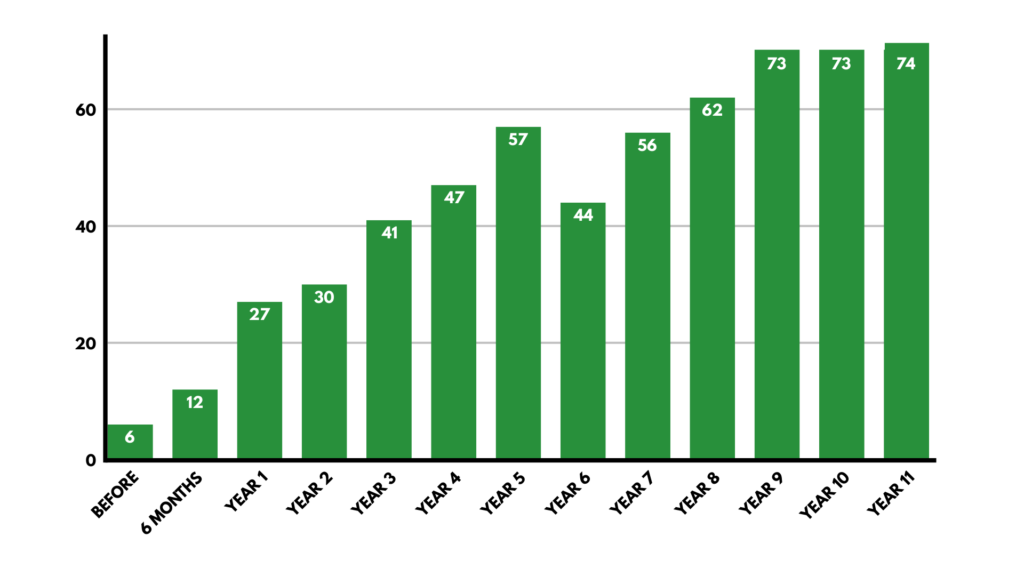
She’s also going to talk about just the last couple of years of success that she’s had. But I went in and pulled out all of her results, and we put together this really cool bar chart that kind of shows her results over the last 11 years. So you can compare year one to year 11.
So we’re going to put that in the show notes page for this episode. So if you’re watching this on YouTube, do use the link below this video to go to the show notes page where you will actually be able to see the bar chart of comparing the referrals she’s received over the last 11 years.
It truly is amazing and she’s not alone. She’s not the anomaly. I have lots of clients like this and I cannot wait for you to meet them all in the Where Are They Now series.
But we are going to kick off this first episode with my friend, the OG of all the clients, And I just can’t wait for you to meet her, Amanda Mingo.
You are going to learn how she learned from me, right? Exactly what she learned from me more than a decade ago, how it continues to impact her and her law practice. So let’s take a listen.
Stacey Brown Randall: Amanda, I am very excited to welcome you to the podcast. I’m slightly embarrassed because I’ve actually never had you on the podcast before and didn’t realize that until I started putting together this, my idea for this, Where Are They Now series with some of the clients that I worked with in the early years of my business.
And let’s just having that conversation about the trajectory that they have gone on with their businesses. And of course, we’ll talk about referrals, too. So I just want to say I’m so sorry I haven’t subjected you to this fun torture before.
Amanda Mingo: Well, that’s quite all right. There’s a first for everything.
Stacey Brown Randall: That is true. That is very true. Okay. There’s so many different places I want to take this conversation because I’m so excited for us to have it.
I feel like for me, you were like the OG, right? Like the first and the finest, right? The one where there’s a couple of, a couple of clients back in the early year where it all kind of started.
And you are definitely one of those first and finest OG clients that kind of went on this journey with me. Like we started out productivity coaching and then we moved into the referral piece as I was developing that.
I always tell the story about in my very first year in business, I got 112 referrals that I didn’t ask for. And you were one of the 112 that I received. You were referred to me. And then we started working together. And it was like a combo productivity, but also the referrals piece.
And I have so many fond memories of sitting in your office on the couch. during our coaching sessions, kind of like getting everything started.
So it is feels very full circle for me, hitting later this year, 13 years in my business, very full circle to come back and to have this conversation with you and to talk about your, I mean, obviously your business journey, but also your referral journey over those almost more than the last decade.
So I’m excited for us to dive in. So Let’s just kind of, let’s just kind of go back to the beginning.
And I think this is a really important foundational question that most business owners have to ask themselves if they’re going to commit to doing the work, to getting more referrals is why are referrals important to you?
So take yourself back to 2013. When we first started working together and you were thinking about doing the work to getting more referrals, why were they important to you back then?
Amanda Mingo: So I came looking for you at a point in which my practice was really changing. I had a partner who left and left a lot of work behind for me to finish up. And as I was wrapping up those cases, it hit me that I wasn’t getting any new work in.
And it was terrifying because I wasn’t quite sure how to go about doing that. That’s not training that we ever got in law school in terms of marketing or building a practice or a book of business or what have you.
And so coming to you for help was the smartest thing I ever did because you basically kind of taught lots of little ways in which to implement a process to get referrals. And for those of us that are small businesses, we’re not putting billboards up and we’re not doing television ads and sending lots of letters, so referrals are the way my work comes in entirely.
And so to figure out how to build my practice meant really getting out of my comfort zone and meeting new people and figuring out how to do that authentically.
And that is something I’m forever grateful for, because to be able to teach people in all different facets and all different businesses how to do this and not a cookie cutter style, but a systematic way that is authentic to each person, I think is just a really unique talent that you have and a real gift to folks who cross paths with you.
Stacey Brown Randall: Thank you so much. That’s so sweet. We could just stop right there. That’s exactly what I needed to hear.
Okay. So I want to talk a little bit about kind of like the evolution of your practice. Like I want you to talk a little bit about like the, what you do, but let’s be honest.
You may still do the same thing that you’ve been doing for as long as you’ve decided to be in private practice, but your business still evolves, right? The practice still evolves.
So before we kind of like get into all the, like the referral stuff that’s been happening, and the referral results and what that’s looked like, tell us what your practice was like back in, we can just say this is not when you started, right?
In 2013 is when I first met you, but like kind of like how your business has evolved just since then, like that evolution of your practice of like, what was it like back then? And what are some differences that you see in it today? Here we are in 2026.
Amanda Mingo: Sure. I think that ultimately the evolution started with that building phase, where I was working really hard at meeting new people, creating connections, finding out what kind of symbiotic relationships we could create with how we could help each other.
And that was something that I really loved about growing my practice was learning more about other people’s practices and figuring out, okay, so, it’s not just who’s referring me business, it’s who can I refer business to.
And so that approach really helped kind of solidify some relationships that have carried me through the years.
And then there was kind of a middle phase where it wasn’t so much meeting new people as it was really building those bonds with the people that I was already kind of working with in that regard.
And so the processes that seemed, you know, to send a thank you note, to call and tell somebody, Hey, I appreciate this referral. And this is what I did with it. Even if it wasn’t one that was for me, right?
The kind of nuanced way of helping my referral sources give me better referrals and kind of teaching a little bit about what I don’t do, was just as important about teaching them what I do do.
So I think that there was a phase where it was more like a honing of those relationships. And now it’s in a phase of I still have my keep warm. I still have my running five. I love my running five.
And even if it takes me all year to get to five, you know, it’s like, it’s still really fun to say that person is somebody I wanna know better.
And I really enjoy that aspect that you kind of taught me in terms of getting out of my comfort zone and going to meet people that I wouldn’t otherwise cross paths with.
But now it’s kind of the process is really more kind of taking care of itself in terms of it feels effortless in the fact that it’s very systematic.
When I get a referral, I’m sending a thank you note. At the end of the year, I’m writing people letters about the cases that they sent my way and where they are in the process or whether they’ve resolved.
And I always get great, great feedback. And usually once a year, I try and do something that is kind of an overarching, here’s where I am in the world today. This is the word that I’m thinking of, or this is the concept that I’m thinking of, and sending out a small gift that is reflective of that.
And I think it was probably, I don’t know, six years ago, I sent out a bookmark, and I had somebody the other day come up and say that that bookmark was up on the bulletin board in their office.
So it’s something that is meaningful to people. And I love that part. And that isn’t something I think I ever would have thought to do without working with you and without developing my own system that was authentic to me.
Stacey Brown Randall: Yeah. And I think that, you know, I just want to pause for a second too, because I also think that there are some people who believe that certain types of businesses or certain types of business owners or industries, it makes it harder to receive referrals.
So as a personal injury attorney, that’s not the only thing you do, but like, but as a personal injury attorney, I think people would say, well, that I mean, what they do, that’s probably one of those industries that it’s not going to be, their business is not going to be fed by referrals.
It’s probably they’re going to need, you know, the online marketing strategies or they’re going to need the billboards or they’re going to need the bus stops or the buses kind of advertising and things like that.
But I think you’ve also proven that that’s not the case for the work that you do. And I don’t mean to reduce what you do just down to personal injury, because I know you do other things. So why don’t you share a little bit about what it is as your practice that you do?
Amanda Mingo: Sure. I mean, it’s hard, right? Because this is an area of practice that nobody wants to be needed. You know, you don’t want, it’s not something that is an everyday experience that somebody has a catastrophic injury or loses a loved one.
And it’s not something you would ever wish for anybody to have to experience. So it’s really more of letting people know that when someone experiences an event like that, there are so many facets in areas that they need support.
And so really, it’s been a bit about kind of showing folks my work and then letting them know that when they come here, we take care of them.
And so then when a friend of a friend calls another lawyer and says, hey, this terrible thing has happened and these folks are looking for help, that lawyer will say, hey, call Amanda because she’s the one who will look after them and take care of them in all the facets of their case, not just the litigation phase.
And so, that has been a really profound place to be, not only to be recognized in that way, but to have the opportunity to help more people.
It’s different. It’s not sales in the sales context. Right? Because I’m not going out to a company that I know needs this widget.
It’s really more of a helping people understand that if something terrible happens, they have a resource and a place to go for help. And so it is a little bit different in that sense of marketing.
Stacey Brown Randall: Yes.
Amanda Mingo: And what you’re hopeful is, is that when something bad happens, that people will think of you. And so staying top of mind, as you always taught, is really important.
It doesn’t mean that you can make a connection and then never have contact with that person again, and then they’re going to think of you. It doesn’t work that way.
Stacey Brown Randall: Yeah, there’s a big difference between keeping in touch and staying top of mind. Well, there will always be from that perspective.
Amanda Mingo: Yeah.
Stacey Brown Randall: Okay. So it’s been more than 10 years since we first started working together and you graduated. I don’t even know how many years ago and I still miss working with you on an ongoing basis.
And you’ve kind of alluded to this, but I’m so I know the answer is yes. But I just want you to talk through a little bit about how relevant referrals are today, just as they are, or just as they were back then.
Like in the beginning, like you mentioned, it was kind of like the it was like the learning, right? It was like the putting that into place and learning how to take the strategies I was teaching you and implementing them.
And then you went kind of through like, you got really good at it. And you kind of went through like a honing phase of like, the tweaking and the honing and making it better. And now, you know, you’re just able to continue to see that the fruits of your labor.
So walk us through a little bit about from a results perspective of just how relevant referrals are today as they were way back in 2013.
I mean, I know when we first started working together in 2014, actually, like it was, there was a couple of months left in the year, and it was about just trying to get you a few new referrals that didn’t come from your one internal partner.
And I remember the first number was like 12 referrals. And it was like, I don’t know how many months it was exactly. And then the very next year, you started getting over 20 referrals.
And it just kind of grew from there. So kind of just walk us through what that’s looked like for you over the last decade or so.
Amanda Mingo: I will say that it has been an upward trajectory from the time I began working with you until today.
There have definitely been, you know, some years where there’s a dip, but never a dip like a plummet. And I have easily been able to look at when I see a dip year, the year before, and what I was doing with regard to my marketing work and my plan in referral-based creation.
So it’s been really remarkable to see the difference. So I’ll have a year where I have a lot of trials and the work work takes over and kind of impedes my ability to do the marketing work. And the next year there’ll be a little dip.
And then the following year, I’m doing my marketing plan and, and it goes right back up again. So it’s been really fun to see the consistency with which this works.
And that’s kind of what, you know, 12 years later, I’m still working that plan because it’s got some real data behind it. And, you know, just even in the last, so I think I had almost 60 attorney referrals last year.
Stacey Brown Randall: Wow, that’s incredible.
Amanda Mingo: And nearly 20 non-attorney referrals. So both of those numbers we track. Both have been going up year over year. And I will say that it feels like far less effort than it did at the beginning.
So that’s, I think that’s the part that I really appreciate too, is that it just becomes part of and enmeshed in what you do, and kind of your process of what happens when a case comes in.
Well, I do all of this with the client, but I also figure out where they came from. And then if it is an attorney referral, there’s this kind of thank you.
And if it’s a non-attorney referral, there’s that kind of thank you. And it, and it just kind of helps. Because the referral stuff is just as important today as it was 12 years ago.
Stacey Brown Randall: Right.
Amanda Mingo: I mean, that is entirely where my business comes from.
Stacey Brown Randall: OK, wait. So that was 80 referrals, 60 attorney referrals, and 20 non-attorney referrals last year. That was 80 referrals.
Because I think the last time we met for coffee was like three years ago. And I remember you being like, I don’t know the number. You probably have it in front of you. I don’t remember the exact number you said in coffee.
But it was like the highest number you had had since we had stopped, like we had stopped working together, but you had kept the plan going.
And I remember the last year we worked together was also at that point, the highest year as well. So it sounds like that trajectory, like the highest year gets beat by the next, whenever the next year rolls around with the next highest year.
And so I know when we were working together, it was like, oh my gosh, we’re getting more than 20 referrals a year. And then you were like getting into the thirties and the forties and then I know fifties and now into the eighties.
And that’s a growth trajectory that is very, very impressive. And I love knowing that it continues to work for you. But what I love even more than that is knowing that you continue to work the referral processes.
And that’s why you get to have that success. So that’s really exciting. Anything else with the numbers that you kind of want to share from that perspective?
I know we’ve got a number of attorneys who will probably be listening to this or watching this on YouTube and be like, okay, so what did that actually look like? So just share as much as you want from that growth trajectory.
Amanda Mingo: So practices, I think, are pretty much always evolving. At least ours has. And as we have taken on more complex and larger cases, we’ve had to decline or kind of turn away cases that I probably would have taken five years ago.
And so that’s been very interesting. So even though the number of referrals goes up, it doesn’t necessarily change the number of cases that we take in each year.
And so the difference is, is that we get better and better cases because we have more to choose from, it just helps us to be more selective and more focused with kind of where we want to hone in with our practice.
We’re doing a fair bit of civil rights work, and that is very complex and lengthy. And so we have to be very selective in the cases that we take on in that realm.
But we also have, you know, a whole smorgasbord. We have pool injury cases and carbon monoxide poisoning. And, you know, we represent a lot of folks that have been hit by drunk drivers.
So, you know, there are certain types of cases that we take on and then everything else, we refer to another lawyer or lawyers.
So it’s been really fun to develop a kind of a plan for what we’re going to do with these greater number of referrals that come in and still keep a very robust business in-house.
Stacey Brown Randall: I remember hearing you tell me, I don’t know if it was like our first year or second year working together, that the number of referrals you were receiving was amazing, right?
It was like, wow, this is awesome and amazing. But what you really loved was the ability to be picky on the types of cases that you took.
Amanda Mingo: Yeah.
Stacey Brown Randall: And I think that is, so, so key. I always tell folks, when I teach folks about how to generate referrals, and we’re talking about getting referrals, everybody always thinks we’re going to start with quality.
It’s like quality over quantity. That’s the buzz. That’s the cliche that people say. With referrals, it’s actually the opposite. We actually want to start with quantity.
We want to know that you can generate them, that you can follow the process, that you can follow, like what you mentioned, the running five, keeping warm.
Which funny aside, like that’s what I’ve been calling that part of the referring to training strategy since that’s what I named it for you more than a decade ago, like 12, 13 years ago, whatever it was. I called it the running five, keeping warm.
And like, it’s because that’s what I called it with you. And then I just, the name stuck forever. And then we always say the fives of two, so everybody picks their own number, but your number was five. And so it’s always been called that.
But I think that’s the piece that kind of understanding and seeing is that ability to allow you to really decide which cases you’re going to take and which things you’re going to do.
And that’s more than just the how many more referrals can I get. So we start with quantity. Can you generate referrals?
It was important for me to see that you could go from getting a couple of referrals a year from an internal partner to getting 12, in I don’t know, let’s just say was six months, it was definitely not your first full year, and then to take that number to like 27.
Like, it was important for me to see that you could do the work to develop the relationships to really be able to generate the referrals, but very quickly we switch from a quantity to a quality because then it’s like hey, you can still get all the referrals but let’s make sure we’re taking the right ones.
You’re not taking everything just because it was referred to you. You get to go be a blessing to some other attorney by referring out what you’re not going to take. And that’s a wonderful thing to be able to do.
Not everybody can do that, but that’s great that you can and a lot of attorneys can. And I think that’s really important that people understand that, yeah, that quantity piece is great.
And when we talk about numbers, right, when you’re going from like 12 to 27 to like 80 last year, like that’s amazing and that’s awesome and that feeding you those numbers every year.
But for you, eventually it was the switch to, OK, quantity is there. Now I get to focus on quality. And that’s a switch that happens. And it’s really, really important.
Amanda Mingo: Yeah. And I think that it’s, that switch happened several years ago and that part hasn’t changed.
I mean, we turn away more cases than we take every single year and really it’s because we want to do the best work we can do for the clients that we do have. And the only way we can do that is to be selective.
So I think that the whole basis of quantity is also because that is reflective of how many people know kind of what you’re doing. And they’re feeling like, OK, this is a person I can trust.
And this is a person who I know, even if they can’t help, they’re going to help the person I refer to them find a soft landing spot.
And so, you know, and just because somebody thinks they have a case doesn’t mean they have a case, right? So there are a lot of times where we’re just taking the time to explain that aspect and the reason why there’s not a claim here.
We would never be able to do that effectively if we didn’t have the opportunity to, you know, evaluate lots of cases coming in.
Stacey Brown Randall: Yeah, I think that’s really important. And I think it’s one of those things that people kind of like overlook when they’re just so focused on the numbers.
Like how many referrals do we get? Yeah, it’s great. I want those numbers to be high too, but I want it to mean that you get to be picky on the type of clients you work with and that it means you actually have a high enough closing ratio.
There’s nothing worse than getting a ton of referrals and then like closing like 10% of them. Like that’s another problem we need to solve. Yeah. Most, most definitely.
OK, so as you kind of think through how the last decade plus has been with referral generation being a part of your overall business development and growth strategy, if you had to like totally putting you on the spot here.
But if you had to think about like one sentence or statement or thought that would capture what that referral generation has meant to your practice or meant to you, like what it has meant to you in terms of how it’s changed or impacted the last decade plus. How would you describe that?
Amanda Mingo: I would say the most important thing that I learned was the importance of investing in myself.
And that for me meant going out on a limb and doing a program with you that was at that point a stretch financially and otherwise. Timewise, you know, emotional investment, it was a stretch in every category.
And so in order to go from where I was, I needed to change something, right? I needed to make a shift. And the first thing I needed to recognize was the importance of investing in myself.
And for me, that meant changing the way that I approached getting business and to learn a new method.
And so I would say to anybody, whether it’s a business coach, whether it’s a referral marketing coach, whether it’s a life coach, whatever, the most important thing I think you can do if you want to see real change is to invest in yourself.
Stacey Brown Randall: Amen. I could not agree more. Yeah, that’s awesome. Okay. Amanda, thank you so much for spending time with me today.
This was so fun for us to do a little walk down memory lane with one of my, I was going to say oldest, but that doesn’t sound good for either one of us, right?
One of my long-term, one of my first clients, let’s say it that way. One of my first clients, that I ever had the opportunity to work with.
Thank you for being a part of the, Where Are They Now, like, what is this referral journey look like for you. So thank you for being here on the podcast today. I really appreciate it.
Amanda Mingo: Absolutely. It’s been fun. Thank you, Stacey.
Stacey Brown Randall: I can’t express enough, I think, how grateful I am for Amanda. And not that she was just willing to come on the podcast. I was kind of embarrassed to realize I’d never had her on the podcast before.
If you’ve read my books, she’s been mentioned. If you’ve ever heard me talk about one of my strategies called the Running Five Keeping Warm, if you’ve ever heard my clients talk about it on a podcast episode, that was named, that was what I called it when I actually created it.
And I gave it a name so Amanda could remember it when I was teaching it to her. She was the very first client I ever taught it for and running five was hers. So we’ve used it for everybody.
I mean, everybody creates their own number, right? I always say the five of twos, but she is such an integral part of the belief that I had in myself and the longevity of knowing what I teach works year over year over year.
Of course, she’s not the only. I’m really excited for you to meet some other clients that I’m going to bring on the Where Are They Now series. I’ve actually already recorded another one of those interviews, and I’ve got a bunch more coming up, so I can’t wait for you to meet these folks.
Because this shows you that, yes, you can learn from me and implement something for a year or two, or you can decide to learn from me and implement it for a decade and have success.
It’s just a choice. That’s what it comes down to. You can choose to grow your business in a lot of ways. Trust me, referrals is probably the best way. It’s definitely the one that speaks the most to you in terms of how valuable you are when people refer to you.
So if you’re going to have to grow a business, might as well do it in a way that is fun, right? And that you can actually enjoy. And referrals is definitely that.
And Amanda is a big part of showing folks year over year, somebody who learned it and then continues to put it into practice, right? Continues to put it into practice as she moves through every single year in her business.
And as she’s brought on different support and admin, they’ve just picked up the process and kept it going with her. And she is walking success. She’s walking proof that if you keep it going, it’ll keep serving you year over year.
Not perfectly, not like you can snap your fingers and say, I’m going to get this many referrals this year. But if you do the work, the referrals do come. And that creates an amazing amount of consistency and sustainability in her practice.
So I’m so glad that as I kicked off the Where Are They Now series, Amanda was the first to say yes and was the first for the series, because it is so fitting as the OG client of mine that she would be the first on this series.
So I hope you enjoyed this interview and, of course, all the other ones to come in the Where Are They Now client series.
You can access Amanda’s contact information if you want to connect. Also, the transcripts for this episode and any resources mentioned on the show notes page at StaceyBrownRandall.com/404.
Thanks for making it to the end. Until next week, take control of your referrals and build a referable business. Bye for now.